

Part 1
The Supremacy of Trees
We humans think a lot of ourselves, and for good reason. We've taken over this planet, changed it forever. Even if we all vanished tomorrow, the evidence of our domination of Earth would last millions, maybe billions, of years. We are the hot, trendy organism of the Holocene, today's It species. We've barely been here a minute geologically speaking, we're the new freshness. There were no humans a million years ago - barely a blink of the eye, in the lifetime of Earth.
But we stride this world like we own it. Every other living system bends when we walk over it. We are irrevocably changing Earth systems. The only other living things that can keep up with us are probably bacteria, but honestly, they dominate every age.
Strange things happen when the balance of Earth systems get out of whack. We are learning the hard way, as our planet starts to cook with all the CO2 we've put in the air by burning fossil fuels. Primarily, throughout our history and up to the present, we burned coal.
You may have wondered where all this CO2 came from, why it was part of the earth beneath our feet in the first place. Or it might have seemed to be there from the dawn of time, just a property of the planet humanity so recently came to dominate and change. There is a story here, one that we can identify with, a story so close to our own that we humans could reasonably be called Chapter Two.
The ages of Earth are like the chapters of the grandest book, in the human study of Paleontology. They go from a mere lifeless rock in the orbit of our sun, up to our strange selves, in roughly 14 chapters. But what concerns us here is the first age of trees.
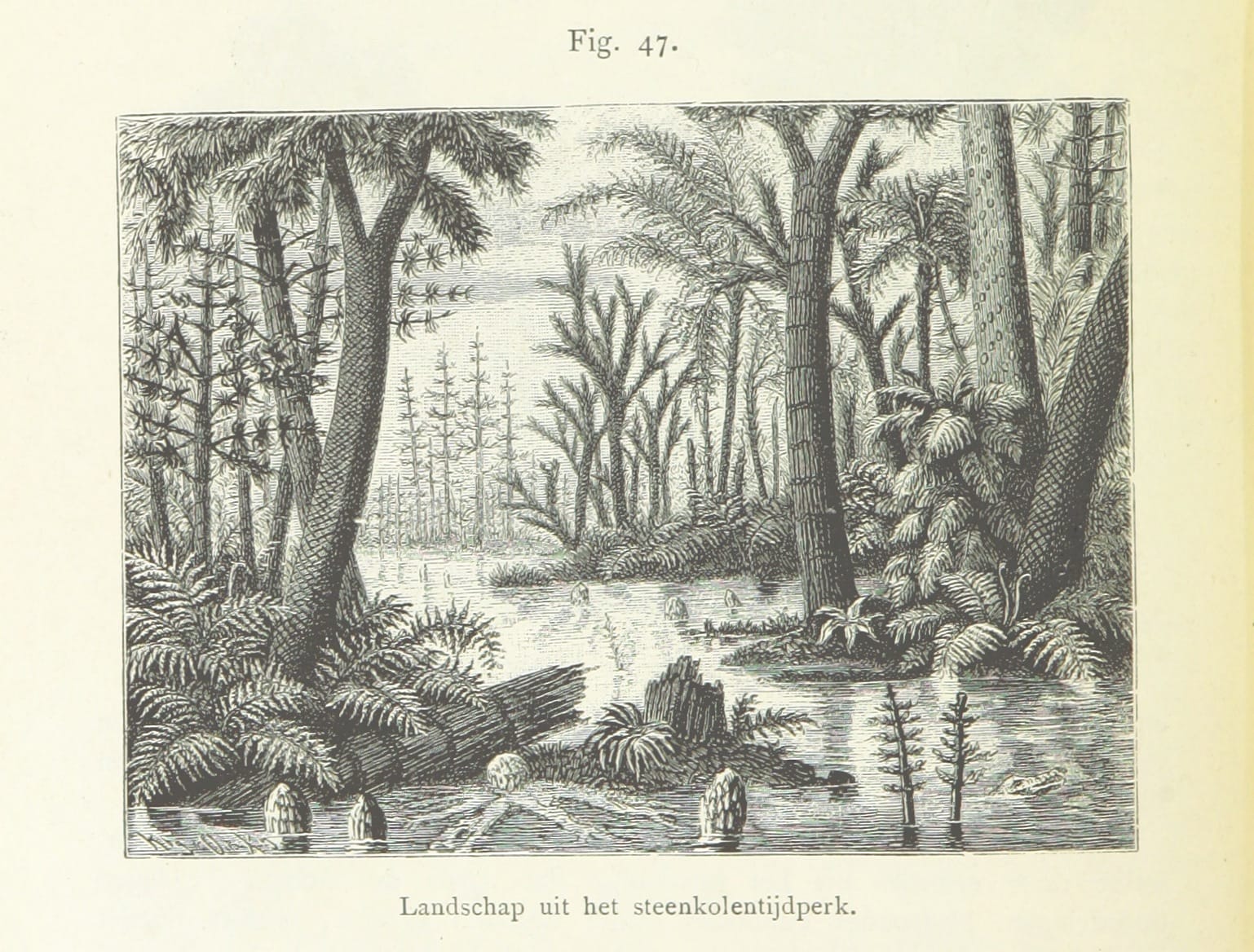
It was 350 million years ago that this new age began, defined by another incredible species as successful as we are now. They were the Carboniferous trees, and in many ways our spiritual ancestors, though obviously not literal ancestors. Our literal ancestors were also there, looking a lot like small dog-sized lizards. Technically they weren't lizards; true lizards wouldn't come around for a while yet. But our ancestors did live in these first forests, their first home on land.
The Carboniferous was an age like no other that came before in the history of Earth. Giant trees called Lepidodendron dominated much of the world, and irrevocably changed it. Called "Scale trees" by humans, the Lepidodendron weren't trees in the way we have them now. They looked a little bit like palm trees topped with a bushy crown of pine needles. Instead of any kind of bark, they were covered in a pattern of diamond shaped scales; hence "scale tree." They were nearly everywhere, and grew with wild abandon.
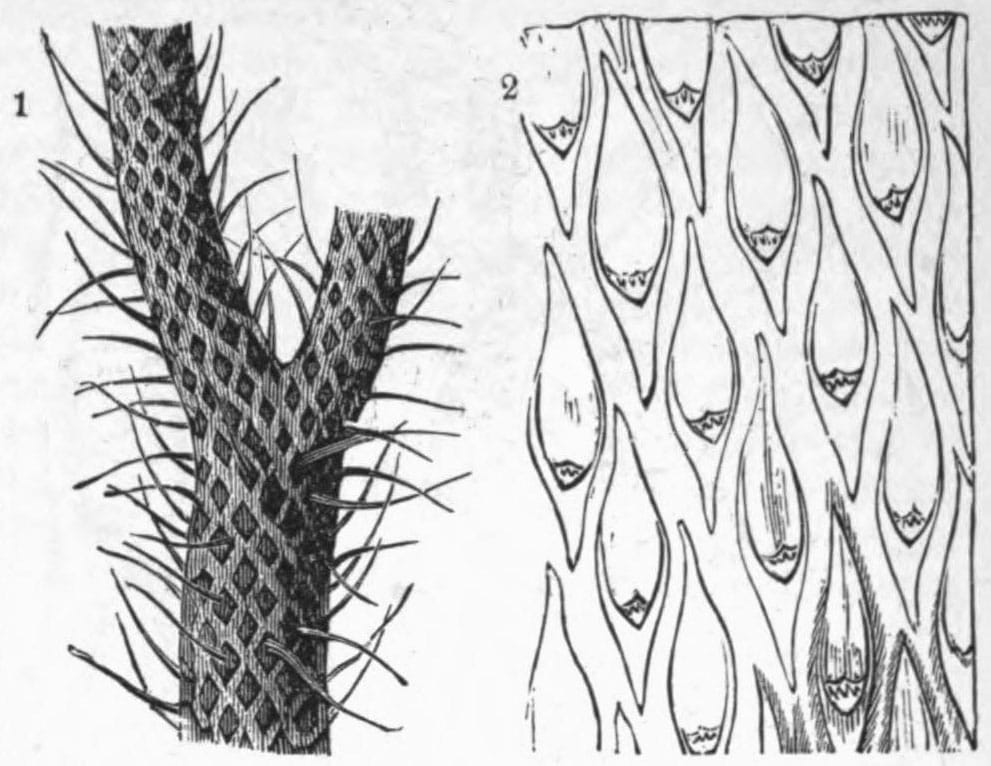
Since we both first evolved, plants and animals have reversed each other's way of breathing in the world. Plants, including the Lepidodendron scale trees, eat up CO2 and and get rid of oxygen, expelling it back into the air. Animals breathe oxygen in, and throw CO2 back out in the atmosphere with every breath. It's a great regulating system, as long as the plants and animals keep each other in balance. If you could visit the Carboniferous, (and bring your own breathing apparatus) You would find an alien world, dominated not only by scale trees but a wide variety of truly unacceptable insects. These bugs were pure nightmare fuel.
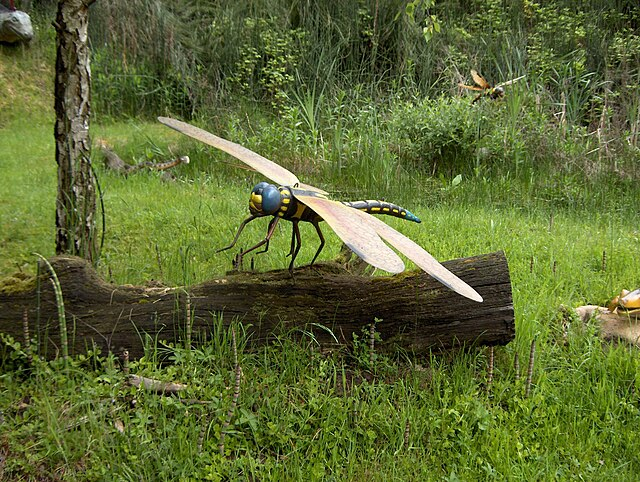
Insects don't breathe per se. They just let the air diffuse into their bodies through openings called spiracles. That means that their size is always a function of how much oxygen is available in the air. After the scale trees took over the world, there was too much oxygen in the air.
Carboniferous insects were huge. Just unacceptably large. Think of a dragonfly buzzing near your head, but the size of a crow.
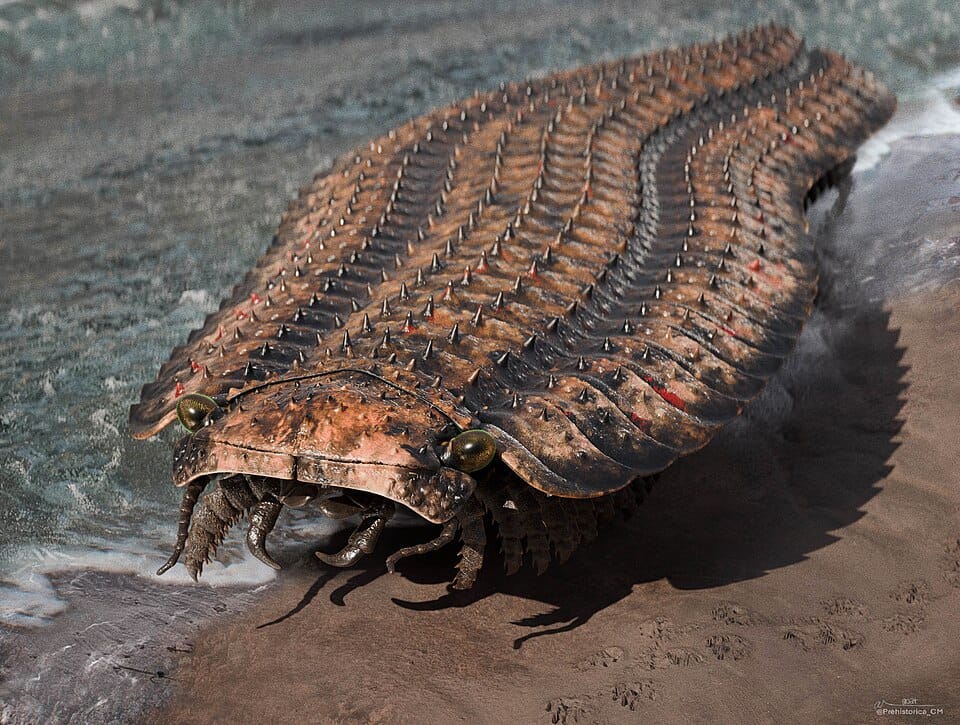
There was also a poisonous millipede called Arthropleura which was the length of a surf board, and probably hangry. It had so many legs, just too many. Scientists debate how many legs it had, because it was that many legs.
As for the rest, there's a wide collection of scorpion-like 10 legged abominations. One called Pulmonoscorpius was pet sized, for a maximum of NOPE. All of nightmare fuel was created by the trees that were breathing out so much oxygen, making the insects as big as they would ever be.
What the plants were breathing in was CO2, using the carbon one molecule at a time to make ever more of themselves. And they did make so many of themselves that they changed the planet forever.
It turns out that for all our faults, humans aren't the first Earthlings to make poor climate choices. The scale trees grew higher and broader than any plant had before them. They completely filled the land. In the process of dominating the earth, they sucked up far too much CO2 out of the air. The air slowly but surely became a little drier and colder. They grew to be the tallest plants that had ever existed, and numerous as the stars that some horrific large flying bug probably used to navigate. In the process, the trees emitted so much oxygen, that if you were transported there, the air would be too much to breathe safely. It would poison you with oxidative stress.
The Carboniferous was the reverse of our climate crisis; without enough CO2 in the atmosphere. the Earth cooled. Cool air can't hold as much water, and so the land became a bit drier, and then a bit more drier. As that atmosphere was continually filled with more and more oxygen, the Earth kept cooling it just as surely as we are now heating it with CO2. Nothing was moderating the carboniferous cooling. Eventually the world hit some kind of tipping point – the carboniferous ended in a sudden mass calamity of tree death. This was the end of the Carboniferous world, the extinction event that gave way to the Permian era.
Most of the eras of Earth are marked by inanimate disasters, acts of God like the volcanos that ended the Permian or the meteor that killed the dinosaurs. These were events that no mere paper-thin layer of life on the Earth could either cause or resist, just the routine violence of space and physics. They were mechanical and unfeeling endings of grand planetary ages. But the End Carboniferous was different. The greed of life inflicted this mass death on itself. In this case it was the unconscious greed of trees. But physics is physics, whether you meant to or not.
The dead bodies of these trees, too numerous to imagine, collapsed and sank into the ground, practically simultaneously on the scale of planetary End Time events. Their uncountable bodies pressed down on each other and the earth. They compressed and transformed for millions of years. They arrived at their deep graves as new eras of life evolved, and had their turns, and ended, like all ages do. Through millions of years, the long-dead scale trees turned into a black earth of long chain carbon deposits, pressed into the endless black of death deep underground.
But they didn't vanish, nothing in this universe vanishes. They just rested in their graves, pressed upon by the world above, changing, simplifying, becoming something else, something we would come to desire.
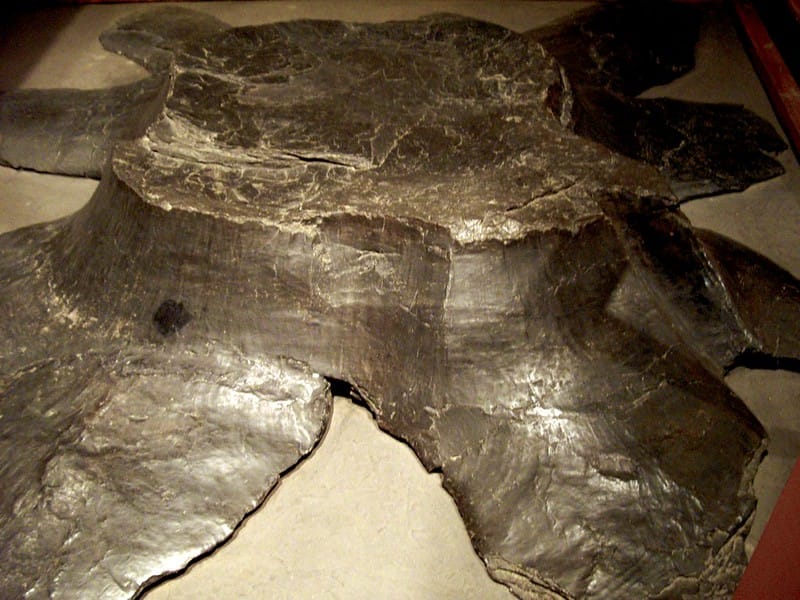
Today we call these dead bodies coal. Carboniferous scale trees are still the largest single part of our CO2 emissions, and largest part of our fossil fuels. If there is a god looking down on all of this, the act of us digging up these old carboniferous remains to return their stored heat to the atmosphere must have a pleasing symmetry to it.
We are killing ourselves with climate change (again), by returning the scale trees to the surface of the world, and undoing their oxygen crimes with our own carbon dioxide crimes. We are releasing their ghosts into the air we breathe in our wild and unstoppable desire to grow, use more, burn more, spread more, be everywhere and always the sovereigns of the earth, like the Lepidodendron once was.
This time though, we are the kind of Earthlings that can know what we're doing while we are doing it. It remains to see if we are the kind that stop the cycle in time.
Life learns, but it never learns easy, including human life. We've replaced the plant-greed with a greed for the imaginary ideas of money and power. We're rationalizing it in our society based on a certain capitalist theory of economy, which has often depended on the coal graves of those trees. (And more recently, added the dead, compacted bodies sea creatures as oil and natural gas)
Organisms, I tell ya, they never stop being crazy.